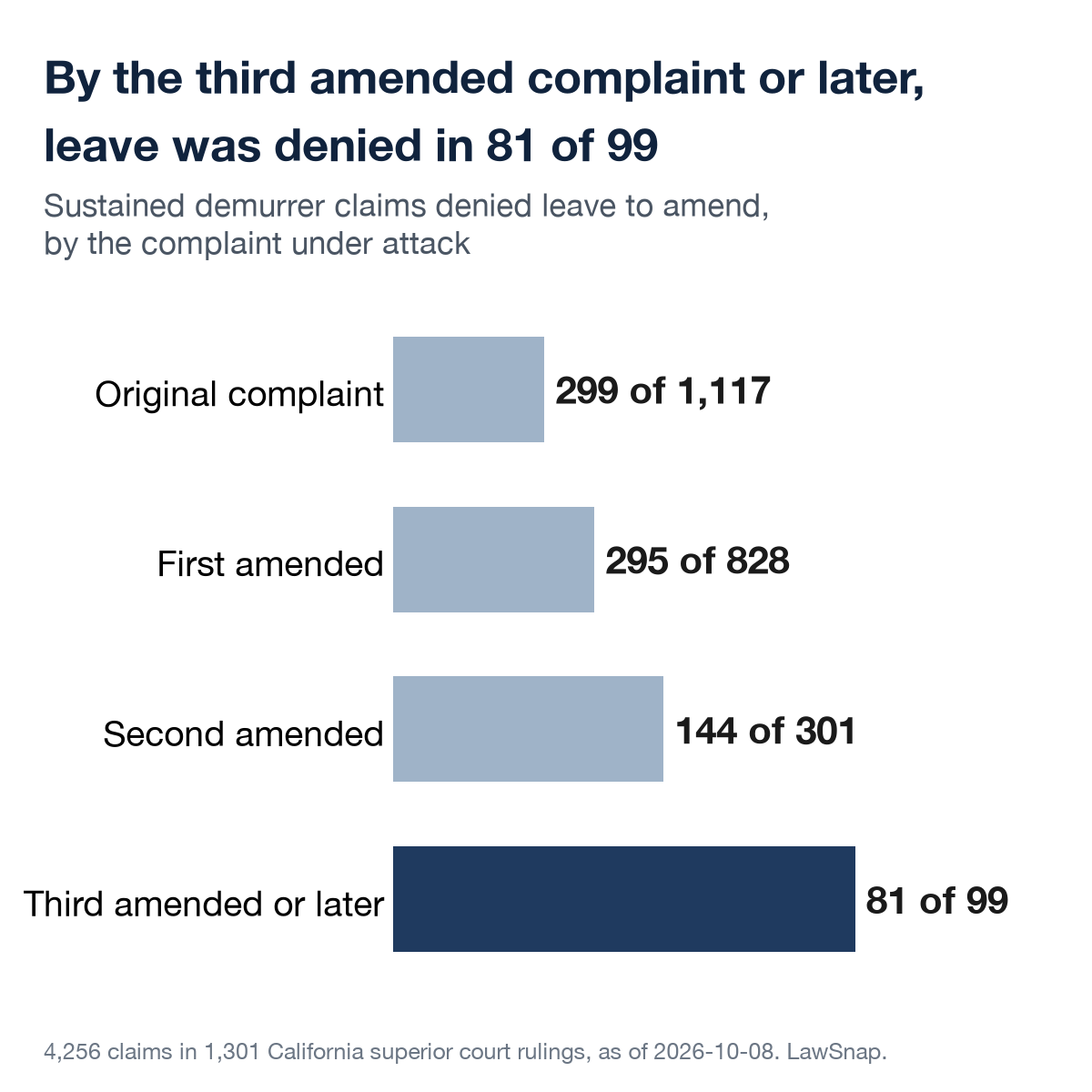
The court sustained the demurrer. Do you get another try? Early on, you usually do, but by the third amended complaint or later, leave was denied in 81 of 99 sustained claims.
The number
We looked at 4,256 demurrer claims in 1,301 California superior court rulings. Each ruling named the complaint under attack. As the rounds went on, courts denied leave to amend more often.
| Complaint attacked | Sustained without leave | Sustained with leave |
|---|---|---|
| Original complaint | 299 of 1,117 | 818 of 1,117 |
| First amended complaint | 295 of 828 | 533 of 828 |
| Second amended complaint | 144 of 301 | 157 of 301 |
| Third amended complaint or later | 81 of 99 | 18 of 99 |
We counted only sustained claims where the ruling said whether leave was granted.
What decides it
The plaintiff must show how an amendment would fix the problem. The California Supreme Court put it this way: "The burden of proving such reasonable possibility is squarely on the plaintiff" (Blank v. Kirwan (1985) 39 Cal.3d 311, citing Cooper v. Leslie Salt Co. (1969) 70 Cal.2d 627).
On appeal, the court asks "whether there is a reasonable possibility that the defect can be cured by amendment: if it can be, the trial court has abused its discretion and we reverse; if not, there has been no abuse of discretion and we affirm" (Blank).
So be specific. The plaintiff "must show in what manner he can amend his complaint and how that amendment will change the legal effect of his pleading" (Goodman v. Kennedy (1976) 18 Cal.3d 335).
The data show the pattern by round. They do not show the reason each court gave.
What the average hides: negligent misrepresentation
We also looked at the 14 most common causes of action (3,841 claims). Negligent misrepresentation lost at the demurrer stage most often: the demurrer was overruled in only 47 of 190. But a loss was usually not final. When the court sustained it, leave was denied in only 30 of 138.
| Cause of action | Survived (overruled) | Sustained without leave |
|---|---|---|
| All 14 common causes of action | 1,555 of 3,841 | 592 of 2,205 |
| Fraud (all forms) | 391 of 1,036 | 159 of 618 |
| Negligent misrepresentation | 47 of 190 | 30 of 138 |
| UCL (Bus. & Prof. Code § 17200) | 136 of 293 | 33 of 152 |
What to do
| If you're the plaintiff | If you're the defendant |
|---|---|
| Make your first amendment count. On the original complaint, leave was denied in 299 of 1,117 sustained claims. At the third amended complaint or later, it was denied in 81 of 99. | On a third or later amended complaint, ask the court to sustain without leave. Leave was denied in 81 of 99 sustained claims at that stage. |
| In your opposition, say exactly what you would add and how it changes the legal effect of the complaint (Goodman). | At any round, point out when the plaintiff has not said how an amendment would fix the defect. The burden is on the plaintiff (Blank). |
Method and N: 4,256 claims in 1,301 California superior court tentative rulings on demurrers where the ruling named the complaint under attack, coded for pleading round and outcome, as of 2026-10-08. The cause-of-action table covers 3,841 claims in the 14 most common causes of action, as of 2026-10-08. "With leave" and "without leave" counts leave out sustained claims where the ruling did not say whether leave was granted (108 in the round set, 81 in the cause-of-action set). Duplicate captures of the same ruling were removed. These are tentative rulings, and they are not precedent. Nothing here is legal advice.