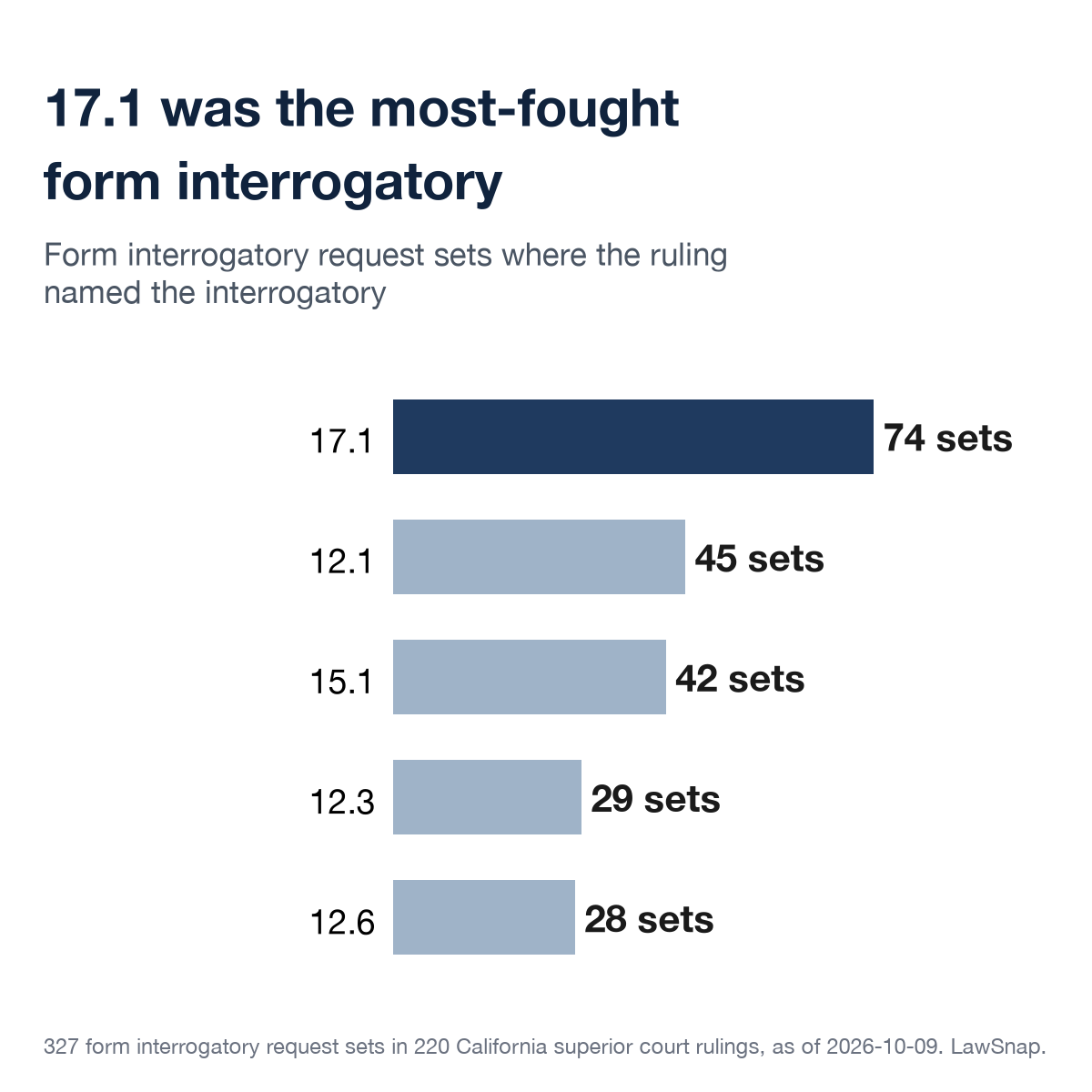
Three form interrogatories came up most: Nos. 17.1, 12.1 and 15.1. But the answer mattered more than the number. Where the main issue was an evasive or incomplete answer, further answers were compelled in 104 of 104 request sets.
Part of a series on motions to compel further responses. Start with the overview: Why Do Motions to Compel Further Responses Lose?
The number
We read 220 California superior court rulings on motions to compel further responses to form interrogatories. They decided 327 request sets. A request set is one set of form interrogatories from one party.
| Outcome | Form interrogatory request sets |
|---|---|
| Further answers compelled (in full or in part) | 214 of 327 |
| Denied | 113 of 327 |
The ones that get fought
These counts cover sets where the ruling named the interrogatory, so they are minimums. They show which answers got fought over, not the odds for any one answer.
| Form interrogatory | What it asks | Sets naming it | Compelled | Denied |
|---|---|---|---|---|
| 17.1 | The facts, witnesses and documents behind each RFA response that is not an unqualified admission | 74 | 51 | 23 |
| 12.1 | The name, address and phone number of each witness and each person with knowledge of the incident | 45 | 32 | 13 |
| 15.1 | The facts, witnesses and documents behind each denial and each affirmative defense | 42 | 30 | 12 |
The form's own words (Judicial Council form DISC-001, the general form interrogatories, Rev. January 1, 2024):
- 17.1 (p. 7): "Is your response to each request for admission served with these interrogatories an unqualified admission? If not, for each response that is not an unqualified admission:" the party must state the request number and "all facts on which you base your response," name the people who know those facts, and identify the supporting documents.
- 12.1 (p. 5): "State the name, ADDRESS, and telephone number of each individual:" including each one "who witnessed the INCIDENT or the events occurring immediately before or after the INCIDENT."
- 15.1 (p. 6): "Identify each denial of a material allegation and each special or affirmative defense in your pleadings, and for each:" the party must "state all facts on which you base the denial or special or affirmative defense," and name the people and documents behind it.
Next most often named: 12.3 (29 sets), 12.6 (28), 12.4 (27), 12.2 (26), 4.1 (23), 9.2 (22) and 50.1 (20).
What decides it: the main issue in the ruling
We could code the main issue for 302 of the 327 sets.
| The issue the court decided | What lost | What won |
|---|---|---|
| Was the answer complete? | Answer found adequate: stood in 38 of 39 | Evasive or incomplete: compelled in 104 of 104 |
| Did the objections hold? | No separate count | Objections overruled: compelled in 47 of 47 |
| Was the motion itself in order? | A procedural defect in the motion: denied in 54 of 58 | No separate count |
Where 17.1 itself was the main fight, further answers were compelled in 15 of 17 sets. Privacy or privilege was the main issue in 17 more (compelled in 16), and 20 turned on other issues.
Evasive answers. "Here, Defendants’ responses to form interrogatories 15.1, 17.1 and 50.1 are evasive, incomplete and do not comply with the discovery code." (Orange, 2024-01448302, 2026-04-27).
Every subpart. "Request No. 50.1. This request was not fully answered as to all of its subparts and therefore further response is warranted." (Contra Costa, C23-02761, 2025-12-18).
A late motion. "Given that the Motion was untimely filed, the Court must deny it." (Los Angeles, 24CHCV04086, 2026-05-26).
What to do
| If you served the form interrogatories | If you're answering them |
|---|---|
| Serve 17.1 with your RFAs, and move when the answers don't give the facts, people and documents. Where 17.1 was the main fight, further answers were compelled in 15 of 17. | For each RFA you did not admit outright, answer every part of 17.1: facts, people and documents. |
| Move on evasive or incomplete answers. Where that was the main issue, they were compelled in 104 of 104. | Answer every subpart. Partial answers to 50.1 were sent back in C23-02761. |
| Meet and confer and file on time. Procedural defects in the motion led to denial in 54 of 58. | If the motion is late or has another procedural defect, say so. |
Method and N: 327 form interrogatory request sets in 220 California superior court tentative rulings on motions to compel further responses, from 7 counties, mostly 2025 and 2026, as of 2026-10-09. This is the form interrogatory part of the same set as the overview. A request set is one set of form interrogatories from one party in one ruling. The main issue and the interrogatory numbers come from a model's reading of the full ruling, used only where the supporting sentence was checked against the ruling. The interrogatory counts cover only rulings that named the number, so they are minimums. The descriptions of 17.1, 12.1 and 15.1 come from the Judicial Council form (DISC-001, Rev. January 1, 2024). These counts describe the court's stated reason, not a predicted chance of winning. These are tentative rulings, and they are not precedent. Nothing here is legal advice.