Across 352 California IIED claims tested on demurrer, claims paired with a habitability or landlord-tenant claim (mold, disrepair, infestation, wrongful eviction) died for good in 10 of 74 decided. Pled as the only claim in the case, 10 of 25 died for good.
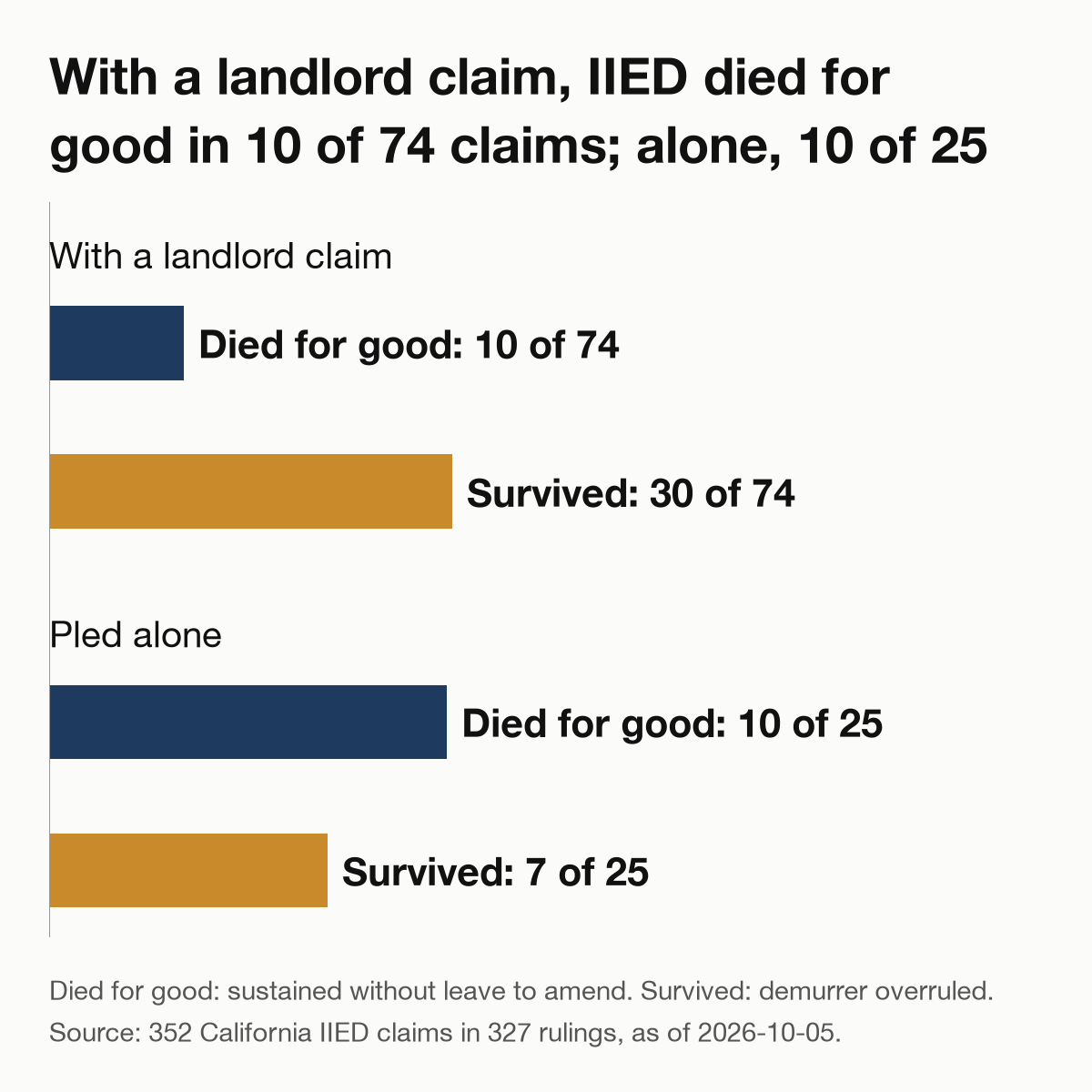
Dying for good means the demurrer is sustained without leave to amend.
| Group | Died for good | Survived |
|---|---|---|
| Paired with a habitability or landlord-tenant claim | 10 of 74 | 30 of 74 |
| Pled as the only claim in the case | 10 of 25 | 7 of 25 |
That is nearly a 3x gap in the death rate. Survival is closer: 30 of 74 landlord-paired claims were overruled, against 7 of 25 pled alone, about 1.4x. Same doctrine, same legal standard. The difference is what the claim is riding next to.
The bar
Intentional infliction of emotional distress has one of the strictest pleading standards in California tort law. Conduct has to "exceed all bounds of that usually tolerated in a civilized community"; conduct that is only unfair, upsetting, or a bad-faith business decision does not qualify. In this set, landlord-paired claims were overruled in 30 of 74 and employment-paired claims in 30 of 78. Both did better than claims pled alone (7 of 25).
Why this pairing works
The authority: Stoiber v. Honeychuck (1980) 101 Cal.App.3d 903 holds that a landlord's knowing, intentional, and willful failure to correct a defective habitability condition can itself satisfy IIED's outrageousness element. Burnett v. Chimney Sweep, LLC (2004) 123 Cal.App.4th 1057 follows it and treats the question as one for a jury, not something a court resolves against the tenant on the pleadings.
A tentative applying it: Case No. 2025-01516756 (Orange County Superior Court) applies it, verbatim: "A landowner who knowingly, intentionally, and willfully fails to correct defective conditions -- including mold -- may state a cause of action for IIED, and whether such conduct is sufficiently extreme and outrageous is a factual question precluding dismissal on the pleadings." The tenant in that case had documented over 20 months of complaints and the landlord's personal awareness of the health impact.
The one question: So the doctrine asks one question: did the landlord know, and did it do nothing? A habitability claim already requires pleading the landlord's knowledge and the condition's severity. Once those facts are on the page, they double as the outrageousness facts IIED needs under Stoiber and Burnett.
What gets pled, and what gets left out
| Language that survives | Language that dies |
|---|---|
| Specific, dated documentation of the landlord's knowledge (written complaints, notices, photos, any record a court can point to), paired with a specific description of continued inaction over a meaningful period of time. | A defective condition described generally, without a clear showing the landlord knew and chose not to act. A dispute over what's "defective," or an ordinary maintenance delay, is not the same as knowing, willful inaction, and courts read the difference closely. |
What this means depending on which side you're on
| If you're the tenant/plaintiff | If you're the landlord/defense |
|---|---|
| Don't lead with how bad the condition was. | A habitability dispute alone isn't automatically outrageous. |
| Lead with what the landlord knew and when, and how long they did nothing about it. | Look specifically at whether the complaint alleges you knew and deliberately declined to act, versus a genuine dispute about severity or an ordinary maintenance timeline. |
| That knowledge-plus-inaction pattern is what the doctrine tests. The condition itself is almost secondary. | If the complaint doesn't plead knowledge and willfulness, that's where to attack. |
Methodology note: 352 IIED claims in 327 California superior court tentative rulings on demurrers, coded for companion-claim category and outcome, as of 2026-10-05. 77 claims were paired with a habitability or landlord-tenant claim; 74 of them were decided (claims the court did not reach, found moot, or left unclear are excluded). The illustrative ruling (Case No. 2025-01516756, Orange County Superior Court) is a non-precedential tentative you can look up on the county docket, cited here for the published authority it applies (Stoiber v. Honeychuck; Burnett v. Chimney Sweep). Nothing here is legal advice.