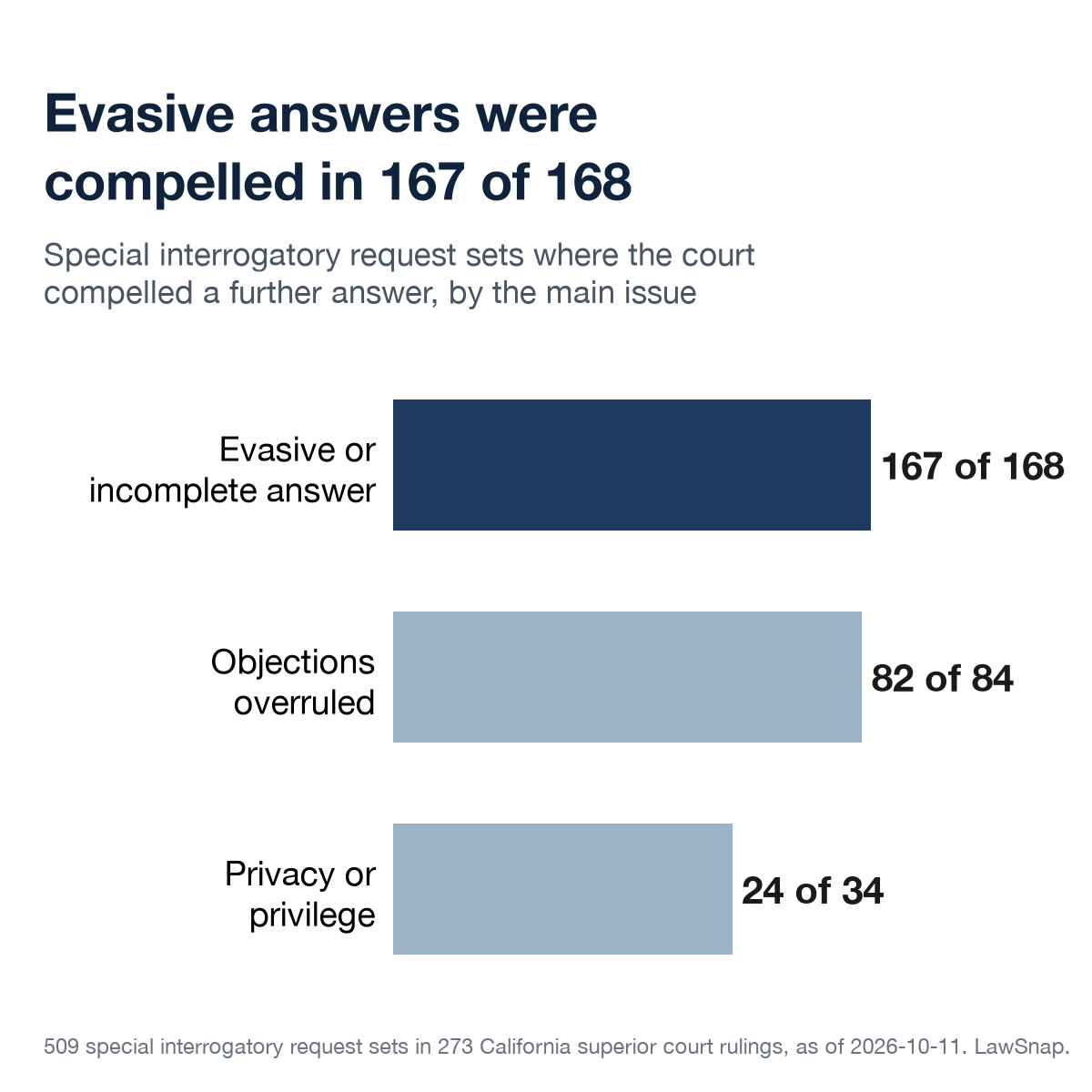
Usually, if the answer was evasive or incomplete. Where that was the main issue, further answers were compelled in 167 of 168 request sets. Where the court found the answer adequate, it stood in 64 of 65.
Part of a series on motions to compel further responses. Start with the overview: Why Do Motions to Compel Further Responses Lose?
The number
We read 273 California superior court rulings on motions to compel further responses to special interrogatories. They decided 509 request sets. A request set is one set of special interrogatories from one party.
| Outcome | Special interrogatory request sets |
|---|---|
| Further answers compelled (in full or in part) | 311 of 509 |
| Denied | 198 of 509 |
What decides it: the main issue in the ruling
We could code the main issue for 483 of the 509 sets.
| The issue the court decided | What lost | What won |
|---|---|---|
| Was the answer complete? | Answer found adequate: stood in 64 of 65 | Evasive or incomplete: compelled in 167 of 168 |
| Did the objections hold? | Overbreadth sustained: denied in 28 of 37 | Objections overruled: compelled in 82 of 84 |
| Was the motion itself in order? | A procedural defect in the motion: denied in 68 of 74 | No separate count |
Privacy or privilege was the main issue in 34 sets. The court compelled a further answer in 24 of them. Another 21 sets turned on other issues.
Evasive or adequate. The line is often drawn request by request. Example of an answer that stood: "Request No. 42: Plaintiff provided an objection but also provided a substantive response. The court finds the response code-compliant." (Contra Costa, C23-01219, 2025-12-18).
Two special interrogatory problems
These counts are small, so we give the counts only. Each covers only the sets where the court's words addressed the issue, so treat each as a minimum.
"See the documents." An answer can point to documents only if it specifies them "in sufficient detail to permit the propounding party to locate and to identify, as readily as the responding party can, the documents from which the answer may be ascertained" (CCP § 2030.230). Where the court found a reference without that detail, it compelled a further answer in 15 of 16 sets. Example: "The Court finds the responses to Special Interrogatories Nos., 6, 12, 14, 15, 18, and 21 make insufficient references to a writing – namely, an 'audit' – in violation of Code of Civil Procedure section 2030.230." (Los Angeles, 24STCV33191, 2026-05-08).
Compound questions. "No specially prepared interrogatory shall contain subparts, or a compound, conjunctive, or disjunctive question" (CCP § 2030.060(f)). Where the court sustained that objection, the motion was denied in 7 of 7 sets. Where it overruled it, a further answer was compelled in 4 of 4. Example: "Ayus’ Special Interrogatories Nos. 14 to 26 and 30 to 33 violate Code of Civil Procedure section 2030.060, subdivision (f)’s prohibition against subparts, compound, conjunctive, or disjunctive questions." (Los Angeles, 22VECV01968, 2026-05-06).
What to do
| If you served the interrogatories | If you're answering them |
|---|---|
| Move on evasive or incomplete answers. Where that was the main issue, further answers were compelled in 167 of 168. | Give a full, direct answer. An objection plus a substantive response can stand, as in C23-01219. |
| Check every "see documents" answer against § 2030.230. Vague references were compelled in 15 of 16. | If you point to documents, name them in enough detail to find them as easily as you can. |
| Write one question per interrogatory. Sustained compound objections defeated the motion in 7 of 7. | Object to real subparts and compound questions. Where the court sustained that objection, the motion was denied in 7 of 7. |
| Meet and confer and file on time. Procedural defects in the motion led to denial in 68 of 74. | If the motion has a procedural defect, say so. |
Method and N: 509 special interrogatory request sets in 273 California superior court tentative rulings on motions to compel further responses, from 7 counties, mostly 2025 and 2026, as of 2026-10-11. This is the special interrogatory part of the same set as the overview. A request set is one set of special interrogatories from one party in one ruling. The main issue and the document-reference and compound-question codes come from a model's reading of the full ruling, used only where the supporting sentence was checked against the ruling. The document-reference and compound-question counts cover only rulings whose words addressed the issue, so they are minimums. These counts describe the court's stated reason, not a predicted chance of winning. These are tentative rulings, and they are not precedent. Nothing here is legal advice. Updated 2026-10-12: counts revised after removing duplicate rulings; no conclusion changed.