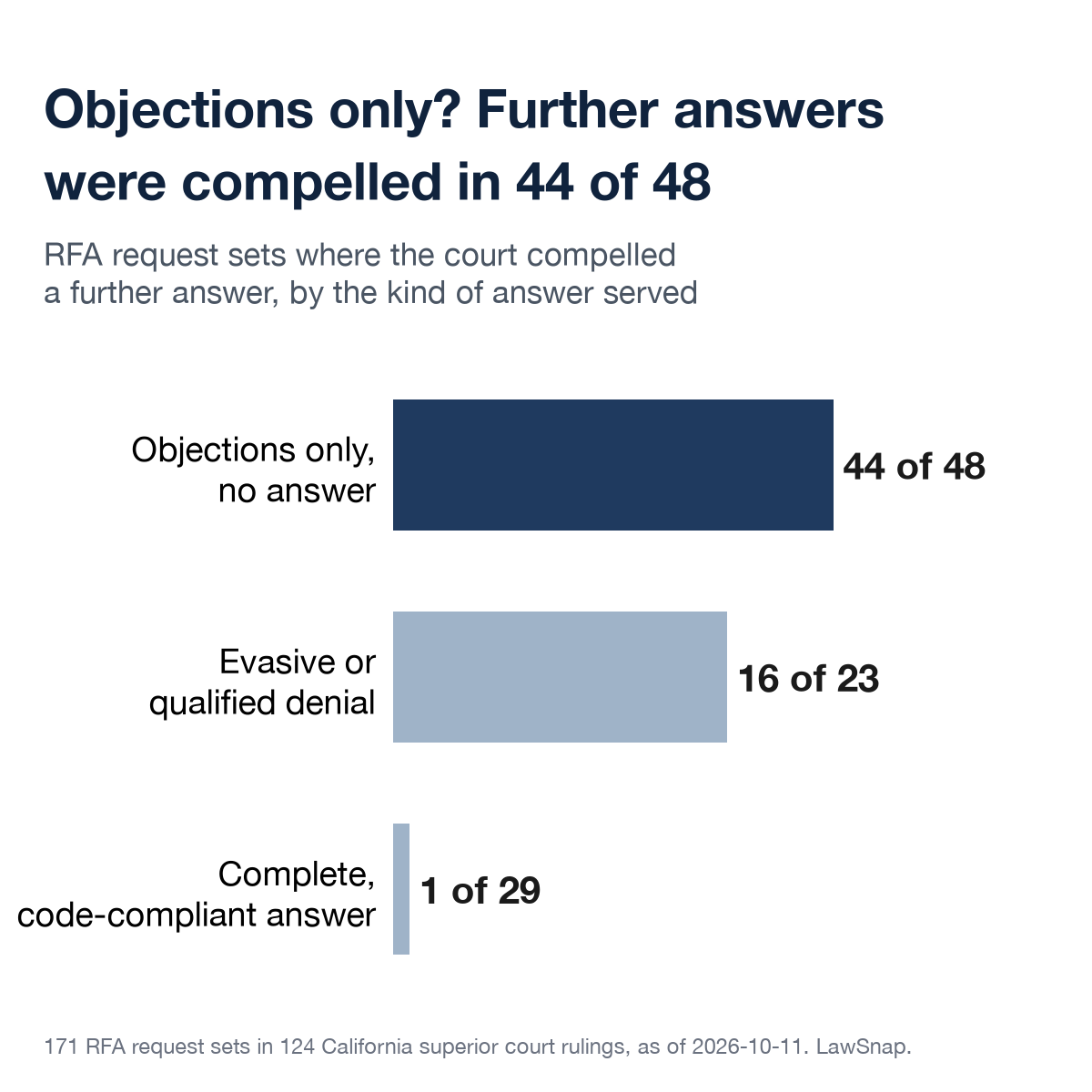
It depends on what the other side wrote. When they answered with objections only, the court compelled further answers in 44 of 48 request sets. When they gave a complete answer, it stood in 28 of 29.
Part of a series on motions to compel further responses. Start with the overview: Why Do Motions to Compel Further Responses Lose?
The number
We read 124 California superior court rulings on motions to compel further responses to RFAs. They decided 171 RFA request sets. A request set is one set of RFAs from one party.
| Outcome | RFA request sets |
|---|---|
| Further answers compelled (in full or in part) | 84 of 171 |
| Denied | 87 of 171 |
What decides it: the answer the other side served
The motion is available when "[a]n answer to a particular request is evasive or incomplete" or "[a]n objection to a particular request is without merit or too general" (CCP § 2033.290(a)).
| The answer at issue | Court compelled a further answer | Answer stood (motion denied) |
|---|---|---|
| Objections only, no answer | 44 of 48 | 4 of 48 |
| Evasive or improperly qualified denial | 16 of 23 | 7 of 23 |
| Lack of knowledge ("I don't know") | 6 of 10 | 4 of 10 |
| A complete, code-compliant answer | 1 of 29 | 28 of 29 |
We could code the kind of answer for 153 of the 171 request sets. Another 43 of those 153 were other kinds of answers and are not shown.
Objections only. "The Court finds the responses to these requests are inadequate in that the responses interpose objections despite the waiver of objections." (Contra Costa, C25-00012, 2026-05-04).
Evasive denial. "The responses are entirely evasive and fail to provide a simple 'admit or deny' on straightforward issues." (Los Angeles, 25STCV06241, 2026-05-04).
Lack of knowledge. The statute requires one sentence. The party "shall state in the answer that a reasonable inquiry concerning the matter in the particular request has been made, and that the information known or readily obtainable is insufficient to enable that party to admit the matter" (CCP § 2033.220(c)). Our set has only 10 of these, so we give the counts only. Two rulings show both sides:
- Statement missing, further answer compelled: "Respondent failed to state Respondent made a 'reasonable inquiry' before representing Respondent cannot comply with the RFA. (See Code Civ. Proc., § 2033.220, subd. (c).)" (Los Angeles, 24STCP02971A, 2026-06-05).
- Statement given, motion denied: "A response that the information known or readily ascertainable is insufficient to answer after a reasonable inquiry is code-compliant under Code of Civil Procedure § 2033.220, subd. (b)(3)." (Los Angeles, 24CMCV01934, 2026-05-19).
Why RFA motions were denied
We could code the court's reason for 82 of the 87 denials.
| The court's reason | Denials |
|---|---|
| The answer was already adequate | 37 of 82 |
| A defect in the motion itself (meet and confer, the 45-day deadline, the discovery cutoff, and similar) | 31 of 82 |
| The objection was sustained (legal conclusion, compound, vague) | 10 of 82 |
| Other | 4 of 82 |
The motion's own defects came close to the adequate-answer count. Example: "Plaintiff’s Motion is untimely." (Orange, 25-01494464, 2026-07-07). The same 45-day rule applies to RFAs (CCP § 2033.290(c)).
A different motion: deem the RFAs admitted
If the other side served no responses at all, the motion is to deem the matters admitted (CCP § 2033.280). That motion is not counted above. In our set, 28 of 35 request sets on it were denied, 3 were granted and 4 were granted in part.
The statute says the court "shall make this order, unless it finds that the party to whom the requests for admission have been directed has served, before the hearing on the motion, a proposed response to the requests for admission that is in substantial compliance with Section 2033.220" (§ 2033.280(c)). The same subdivision adds: "It is mandatory that the court impose a monetary sanction under Chapter 7 (commencing with Section 2023.010) on the party or attorney, or both, whose failure to serve a timely response to requests for admission necessitated this motion."
What to do
| If you served the RFAs | If you're answering them |
|---|---|
| If the other side served objections only, move to compel. Further answers were compelled in 44 of 48. | Answer each request. Where the answer was objections only, further answers were compelled in 44 of 48. |
| If they gave a complete admit or deny, think twice. Those answers stood in 28 of 29. | If you lack knowledge, include the reasonable-inquiry statement from § 2033.220(c). |
| Check each "I don't know" answer for the reasonable-inquiry statement. | Admit what is true. A qualification must be reasonable and clear: the statute allows an admission "as reasonably and clearly qualified by the responding party" (§ 2033.220(b)(1)). |
| Meet and confer and file on time. The motion's own defects caused 31 of 82 denials. | If the motion is late or lacks a real meet and confer, say so. |
Method and N: 171 RFA request sets in 124 California superior court tentative rulings on motions to compel further responses, from 7 counties, mostly 2025 and 2026, as of 2026-10-11. This is the RFA part of the same set as the overview. A request set is one set of RFAs from one party in one ruling. The kind of answer and the court's reason were coded by a model from the full ruling, and the supporting sentence was checked against the ruling. The answer kind was coded for 153 sets and the reason for 159. A hand check of 13 coded sets matched in all 13. Motions to deem RFAs admitted (35 request sets) are counted only in their own section. These counts describe the court's stated reason, not a predicted chance of winning. These are tentative rulings, and they are not precedent. Nothing here is legal advice. Updated 2026-10-12: counts revised after removing duplicate rulings; no conclusion changed.